
Hostility toward churches and Christian institutions in the United States has climbed sharply in recent years, and the numbers are no longer easy to dismiss as isolated incidents.
According to the Family Research Council’s most recent report on hostility against churches, there were 415 documented attacks on U.S. churches in 2024 alone — affecting 383 separate congregations across 43 states. That figure follows 485 incidents in 2023 and represents more than four times the 98 incidents recorded in 2021. Armed incidents specifically more than doubled in a single year, rising from 12 in 2023 to 28 in 2024.
Most churches I know of already have a security team in place, and they should. But the reality many teams haven’t fully reckoned with is what that role actually requires — and how much broader it is than the scenario most people picture when they hear “church security.”
Why Your Security Team May Be the First Responders
Local law enforcement response times vary enormously depending on where your church is located. In many rural and suburban areas, a genuine emergency response can take several minutes to arrive — and in a fast-moving, violent incident, even a response measured in single-digit minutes can be too long.
This is the reality your security team needs to train for: in the earliest minutes of a serious incident, your team is the response. Not because law enforcement won’t come, but because a determined threat doesn’t wait for backup to arrive before acting, and neither can the people responsible for protecting your congregation.
More Than the Worst-Case Scenario
When people think about church security, the mind tends to jump straight to an active shooter. That is a real and serious possibility your team must be prepared for — but it is far from the only scenario a church security team will realistically face. In our experience training church teams across the country, the calls that come far more often include:
- Custody disputes and attempted child abductions between separated or divorced parents
- Concerns involving inappropriate relationships or potential child exploitation within the church community
- Domestic disputes that spill into the church building or parking lot
- General disturbances or conflicts between members during services or events
- Political protests or demonstrations on or near church grounds
- Medical emergencies during services, from cardiac events to falls
- Physical altercations between members
- Severe weather events requiring rapid, organized response
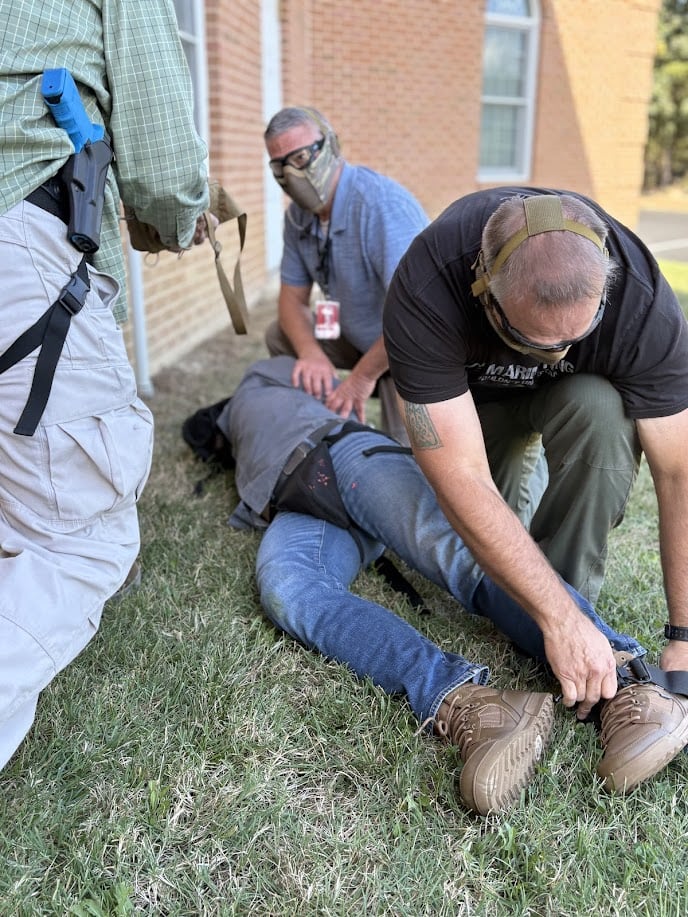
Every one of these situations is something your congregation will instinctively look to the security team to handle — long before anyone considers whether a firearm is involved. A team trained only for the worst case is unprepared for nearly everything else it will actually encounter.
Know Your Role: Not a Guard, Not Law Enforcement, Not Just an Armed Citizen
Even in situations that do require a security team member to draw a firearm, understanding your role matters as much as your technical skill. In most cases, a church security team member is not a state-licensed security guard, and is not a law enforcement officer. At the same time, once church leadership has asked you to serve on the team, you are not simply an armed citizen who happens to be present — you are a recognized, legitimate member of a team with a defined responsibility to the congregation.
That distinction carries real legal, tactical, and liability implications, and it needs to be addressed directly in training rather than left for a team member to figure out in the moment.
There’s an added layer of complexity many churches haven’t fully considered: other members of the congregation, who are not part of the official security team, may also be legally concealed carrying. Informed training has to account for this reality — how your team identifies itself, communicates, and coordinates in an environment where more than one person in the room may be armed.
How Much Training Is Enough?
Once a year? Quarterly? Monthly? This is one of the most common questions church leadership asks, and there’s no single right answer — the honest answer depends on your team’s current skill level, your church’s risk profile, and the reality that most security team members are volunteers balancing this responsibility alongside full-time jobs and family life.
Active Shooter Response Solutions works directly with churches to figure out a realistic training cadence that respects your team’s time while keeping their skills sharp enough to matter. This is a real, practical constraint worth solving deliberately, not defaulting to whatever fits the calendar.
What Our Church Security Team Training Covers
Our one-day church security team training course is built around the full range of situations a modern church security team may face, delivered in your own church building:
- Video case studies of real church violence and disturbance incidents, examined for what worked and what didn’t
- De-escalation techniques for the domestic disputes, conflicts, and disturbances your team is far more likely to face than an active shooter
- Tactical movement within your specific church building while armed — how to move safely, and just as importantly, when moving toward a threat is the right call and when it isn’t
- Live scenario training with role players and simulated casualties, run inside the actual building your team operates in every Sunday
This training reflects your specific building, your specific team, and the specific realities of your congregation — not a generic course built for a different environment.
The Weight — and the Honor — of This Calling
The responsibility you’ve taken on as a church security team member is a heavy one. It may not feel that way on an ordinary Sunday. But the moment something happens inside your church, that responsibility becomes immediate, and your team is the one expected to act quickly and correctly.
It is also one of the most honorable roles a person can take on within their church. Psalm 82:4 says: “Rescue the weak and the needy; deliver them from the hand of the wicked.” That is, in plain terms, what a church security team commits to doing every time the doors open. It deserves to be trained for with the seriousness it’s owed.
Our church security team training is led personally by Kyle Sproles, a 13-year Army Special Forces Green Beret with years of experience serving on his own church’s security team, alongside a background in executive protection. This training is built by someone who carries the same responsibility on his own church’s team — not an outside consultant with no personal stake in the outcome.
Prepare Your Team Before They’re Tested
If your church security team has never trained for the full range of situations they may actually face — not just the worst case — that gap is worth closing now, not after an incident forces the issue.
| TAKE THE FIRST STEP Schedule your church security team training with Active Shooter Response Solutions. kyle@activeshooterresponses.com | (301) 678-3275 | www.activeshooterresponses.com “For the Preservation of Life.” |


Kyle Sproles
Kyle Sproles is a 13-year Army Special Forces (Green Beret) veteran, executive protection specialist, and the Founder of Active Shooter Response Solutions (ASR Solutions). He has trained military, law enforcement, and civilian teams across the world in survival tactics and active threat response, and currently serves as a Special Forces instructor preparing other Green Berets. His work spans campus vulnerability assessments, BECON™️ active threat response training, and emergency action planning for universities, faith-based institutions, businesses, and armed professionals nationwide. Everything Kyle does is driven by a single mission: to save as many lives as possible — For the Preservation of Life.